What is full fibre broadband? Five reasons to upgrade
You may have heard people talking about full fibre broadband, but what difference does it make to your connection and speeds? We explain five ways it could transform your home.

You may have heard people talking about full fibre broadband, but what difference does it make to your connection and speeds? We explain five ways it could transform your home.
By Alex Fletcher
Last updated: March 2026
Reading time: 5 mins
Full fibre broadband is the UK’s most reliable broadband technology. It’s the gold standard when it comes to getting the best connection in your home. It isn’t available everywhere in the country yet, but it’s being rolled out fast by EE and you can check whether it’s in your area using our service checker. The technology used to bring EE Full Fibre broadband into your home, allows you to get ultrafast speeds up to an astonishing 1.6Gbps. These lightning speeds can handle 4K live streaming and serious online gaming. It also means you always get a reliable connection that you can depend on, even when everyone is online.
What makes Full Fibre technology the best?
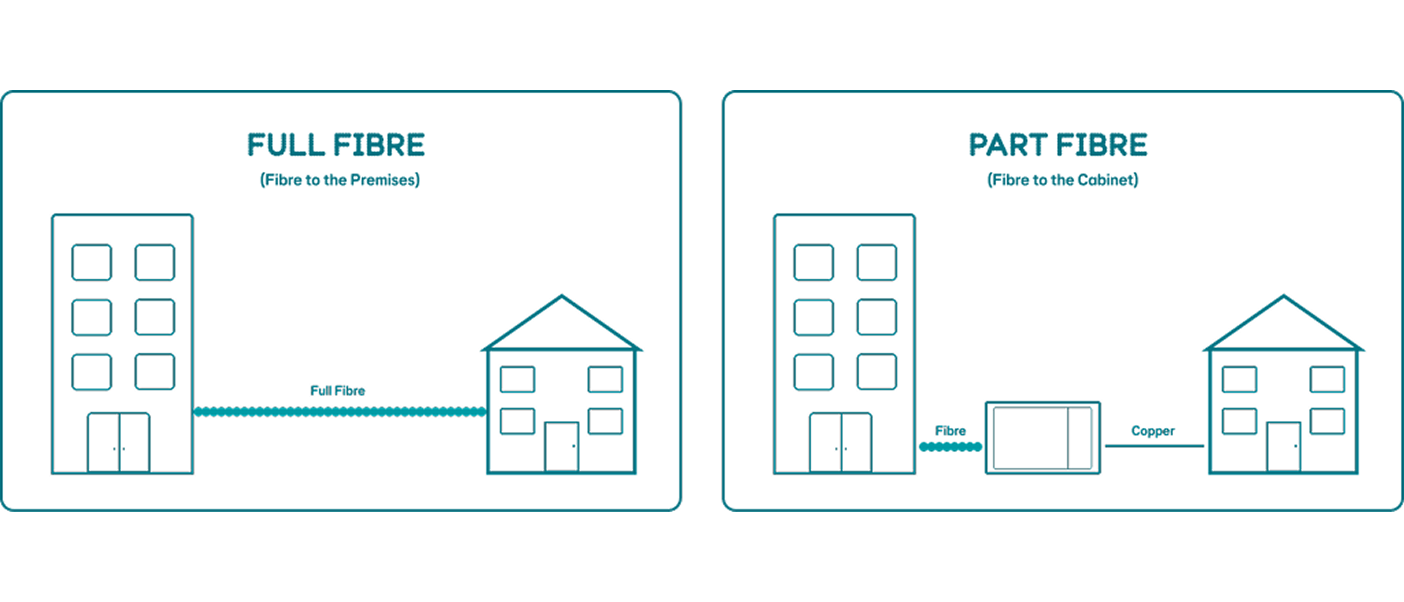
The reason Full Fibre is a significant step up from other types of broadband is because of the way it’s taken into your home. Older broadband technology uses copper cables at some point in your connection. Full Fibre has fibre-optic cables that go directly from the exchange into the four walls of your home. The fibre-optic cables can transmit faster speeds and are less likely to be impacted by extreme weather or heavy usage in your local area. EE Full Fibre can deliver gigabit connections up to 1.6Gbps speeds in some areas, which means you can game online, work from home, make video calls and share large files with ease.
It can often be confusing for customers knowing what connection they have and what is available to them.
There are three traditional broadband types:
Asymmetric Digital Subscribe Line
It’s a bit of a mouthful, which is why most people refer to this as old-fashioned copper broadband. It uses the same cables from the exchange to your home. This broadband has the slowest speeds and is the least reliable.
Fibre to the Cabinet
Fibre to the Cabinet broadband, is usually known as fibre or part fibre. It’s more reliable than copper broadband, because it uses fibre-optic cables to take broadband from the exchange to your local cabinet. However, it still uses copper cable to transfer it from the cabinet into your home.
Part fibre is reliable and with EE you can get average speeds of 67Mbps, which means it can handle a family full of devices, online gaming and video calls with friends.
Full Fibre (Fibre to the Premises)
Full Fibre is the UK’s most reliable broadband technology. It uses fibre-optic cables all the way into your home, which means you can get ultrafast speeds. EE Full Fibre can deliver speeds up to a blistering 1.6Gbps.
ADSL - Asymmetric Digital Subscribe Line
The old traditional copper broadband.
FTTC - Fibre to the Cabinet
Fibre cables bring the broadband to your local area, but copper broadband brings the connection into your home. This is commonly known as part fibre, or previously, fibre broadband.
FTTP – Fibre to the Premises
Fibre cables bring the broadband directly into your home. This is known as full fibre broadband. You need full fibre for gigagbit speeds and ultrafast broadband.
Mbps – Megabits per second
This is a unit of measure for broadband speeds in your home. The unit measures the number of bits you can send and receive. In the old days, measurements came in kilobits, but technology has improved to the point where Mbps is the new standard.
Gbps – Gigabits per second
1,000 megabits equals a gigabit. This gives you an idea on the difference between fibre broadband, which can be around 36Mbps, and full fibre broadband, which goes up to 1.6Gbps.
1. You want game-changing speeds
If you live in an area with EE Full Fibre, you could potentially have speeds up to 1.6Gbps. That is a transformative difference from part-fibre speeds, which average 67Mbps. You can expect crystal clear streaming, even on multiple devices, the very best speeds for gaming, and no awkward lag on work video calls.
2. You live in a busy household
If you live on your own in small flat and only use the broadband for sending emails and internet shopping, there’s no real need for you to move from part fibre to full fibre broadband.
However, if you live in a busy household where everyone is online and there can be people gaming, working or streaming simultaneously, the durability and reliability of a full fibre connection is perfect for your home.
You’ll have less dropouts and more bandwidth – which means a much smoother experience if there are video calls, movie marathons and online gaming happening at the same time.
3. You’re a serious gamer
If you’re a serious gamer or if you have someone in your family who loves gaming online, upgrading to EE Full Fibre when you get the opportunity is your best move.
Gaming online requires lightning-fast speeds if you don’t want lag and slowdown.
Even if you’re not the gamer in the family, you’ll also experience the benefit because the extra bandwidth of full fibre will allow you to do the things you love online at the same time.
4. No more awkward WFH moments
Working from home is becoming more common, but if you’re broadband speed isn’t up to scratch it can be tricky when you’ve got an important call with colleagues.
The speed increase of EE Full Fibre means you’ll have smooth video meetings and no jittering or lag when you’re in the middle of an important presentation.
5. Futureproof your home
Our fastest full fibre is capable of handling up to 190 connected devices. It may sound like more than you need right now, but more and more devices inside our homes use the WiFi. From smart fridges to security systems, our everyday lives are getting more dependent on ultrafast connections. Upgrading to full fibre is the best way to ensure that your home is capable of dealing with this extra demand and any potential speeds increases required in the future.
The speeds and types of broadband available to you depends on your postcode. Use our service checker to find out what broadband is available in your area.
EE is rolling out full fibre all over the UK. However, if it’s not available right now in your area, don’t worry, EE offers a Full Fibre Upgrade. Get a part fibre broadband deal with EE and you get upgraded to full fibre for free, when it becomes available in your area. That’s a promise.